Roof hatches are essential for safe and efficient rooftop access in commercial buildings. Whether you're designing a new facility or retrofitting an existing structure, specifying the right roof hatch can impact everything from code compliance and safety to thermal performance and installation efficiency.
Manufacturers work closely with architects, specifiers, contractors and distributors to ensure roof hatches meet project requirements and industry standards. In this article, we’ll cover the five most important things to know before specifying a roof hatch—so you can avoid costly mistakes and deliver a successful installation.
1. Understand the Access Type: Ladder vs. Stair
The first step in specifying a roof hatch is determining how users will access the roof. This affects the size, configuration, and safety features required.
Ladder Access
- Common in utility rooms, mechanical spaces and service corridors
- Requires smaller hatch sizes (typically 36" x 30")
- Often paired with fixed ladders and ladder-up safety posts
Service Stair Access
- Used in buildings with full stairways to the roof
- Requires larger hatch sizes (typically 30" x 96")
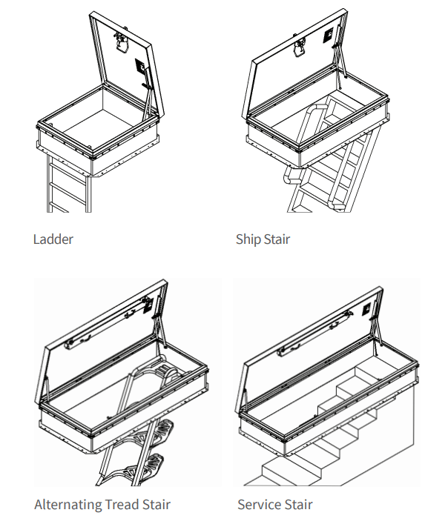
Babcock-Davis Roof Hatches are available in both single- and double-leaf configurations to accommodate ladder and stair access.
2. Choose the Right Material for Your Environment
Roof hatches are exposed to weather and environmental conditions. Selecting the right material ensures durability and long-term performance.
Galvanized Steel
- Most common
- Ideal for industrial and institutional buildings
- May require additional corrosion protection in coastal areas
Aluminum
- Lightweight and corrosion-resistant
- Best for coastal, humid, or chemically exposed environments
- Easier to handle during installation
Stainless Steel
- Maximum corrosion resistance
- Suitable for harsh environments or high-end architectural finishes
- Coastal, humid or chemically exposed environments
Babcock-Davis offers roof hatches in all three materials, with optional powder coating for added protection and aesthetics.
3. Ensure Thermal Performance
Roof hatches focus on energy efficiency and reduce condensation.
Key Features to Look For:
- Insulated lids and curbs (3” of insulation) to reduce heat transfer
- Thermal breaks to prevent condensation
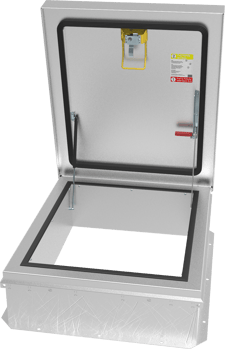
Thermally broken roof hatches from Babcock-Davis help meet energy performance goals while maintaining safe access.
4. Plan for Safety and Fall Protection
Roof hatches can pose fall hazards if not properly protected. OSHA and IBC require safety measures for roof openings.
Recommended Safety Accessories:
- Roof Hatch Safety Rails – Provide guardrails around the opening
- Ladder Safety Posts – Assist with safe transition from ladder to roof
- Self-closing gates – Prevent accidental falls
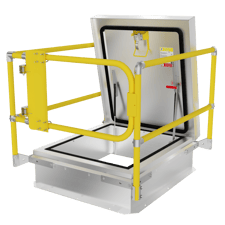
Babcock-Davis offers integrated safety systems that meet OSHA 1910 and IBC Section 1011.12 requirements.
5. Coordinate Installation with Roofing Trades
Proper installation is critical to ensure weatherproofing, structural integrity and code compliance. Coordination between trades—especially roofing contractors—is essential.
Installation Best Practices:
- Use factory-welded curbs for dimensional accuracy
- Flash and seal the curb according to roofing manufacturer guidelines
- Align hatch placement with interior access systems
- Install safety accessories before final inspection
Frequently Asked Questions
Contact Babcock-Davis
Need help specifying the right roof hatch for your commercial project? Contact Babcock-Davis for expert guidance, product documentation, and distributor support.